Sunday, 27 February 2011

Humble Humbrol


George Shaw paints the suburbs of his youth, the Council Estates  where so many of us have grown up. He uses Humbrol enamel paints which  evoke nostalgic thoughts in the artist-and in this writer. This medium allows Shaw to achieve an ultra-bland surface to his paintings (on panels). What he says about nostalgia is fair enough. But when he contrasts enamel paints with oil paints which he sees as being more appropriate for religious or High Art then we are on the level of whimsy. Oil paint is nothing more than a traditional medium which can and has been used to paint grand or  humble  objects. It is as basic as Humbrol enamel or egg tempera .

Another peculiarity is his concern with  titles. He found himself a good one in the  title for the show which apparently comes from Hardy. It is "the Sly and Unseen day". In fact it is  condensation of Hardy's phrase , " a day which lay sly and unseen among all the other days of the year"*.The artist  told The Observer that he had chosen "bumptious" titles for his deadpan, photographically dependent paintings in order to prod the viewer into thought.  Well, the most obvious thought is why does he distract the viewer with these pretentious titles? What you see is definitely what you get  and the results lack life. It seems that the titles are trying to force something which isn't there in the unrelenting banality of the images. A room of drawings was due to open but was not available at the time of my visit.

The George Shaw exhibition is on at the Baltic Kunsthalle in Gateshead.

*Chapter XV: referring to Tess's musing on the unknown day when she will die.

Wednesday, 30 June 2010

why I wouldn't buy this "Picasso"


 Firstly this product was not authorised by the artist himself. The Picasso estate may have allowed  the reproduction to be made but the artist never gave his consent. I suppose it may be that they are marketing a little of the artist's mystique. Well, Picasso is dead, you may say-he could not give his consent-this precisely is my point. He is buried at Vauvenargues and has been these nearly 40 years.

Notice that I call this a reproduction, not a print. Picasso actually made prints throughout his career and the originals cost an arm and a leg as they say. Well more than an arm and a leg, you are talking in tens and hundreds of thousands of pounds for linocuts cut by the artist, or etchings or engravings where the design was incised or drawn onto the  plate by the artist. And another thing: the edition numbers on Picasso originals reflect the fact that they were made with the traditional techniques of the artists' print-in other words by hand. Nothing like it happened here and the vendors can rely on the fact that there doesn't seem to be a legal definition of  the word "print". From the point of view of artist printmakers a print would require considerable input from the artist whilst being printed by himself or with close supervision of experienced craftsmen.

This print is produced on reasonable quality French paper and I am sure that the advertiser can be confident that the printing inks are as good as they say they are. But personally I would not want to buy this item because of the factors listed above. Authorisation from the original model is neither here nor there. Numbered certificates of authenticity are just trappings. What is not stated here is if the 595 copies represent the whole number of "prints" produced. Are there another 595 available say in France and another 595 available in the USA-I have no idea. This form of marketing has been known in the promotion  of teddy-bears.

To me this is a high quality reproduction of a drawing but not a print. Obviously the sellers disagree but I would say that if you want to buy an original work you can get a print or a painting original from a living artist for less than you are being charged here. But some living artists also sell reproductions to make money. When next you go into a cafe or art gallery and  perhaps see a "print" by an artist  and it is signed in pencil with the number 325/550 or such like, please be advised that what you are seeing is possibly a reproduction. They can call it a print if they like . To me the original work was the watercolour which was reproduced. Artists' prints tend to have smaller edition sizes rather than larger  as a rough rule of thumb . If you want to buy a print I would advise that you find out about the techniques used .I would be astonished  if this image of Ms David had any significant resale value or gained value as an investment. Caveat emptor as they say.
There is a typo? in the item's description. Picasso lived at Vallauris not Vallouris.
For further info on printing and editions take a look :here
UPDATE:An example of this reproduction was offered at Anderson& Garland on August 09,2016. as lot  16. It did not sell.

Thursday, 20 May 2010

dunstanburgh, lovely dunstanburgh.

This last few days I have been twice to Craster in the evening and walked along to Dunstanburgh to enjoy the bright yellow whin and the long shadows cast by the declining sun. Saw quite a bit of wildlife in the boggy area near the castle . There were two swans and various other geese and ducks, lots of tadpoles too. No legs yet that I could see. Caught a glimpse of a very big bird  making off; possibly a heron. The bracken has just come through and has the curled look of a bishop's crozier.

Friday, 7 May 2010

the sculptor's business

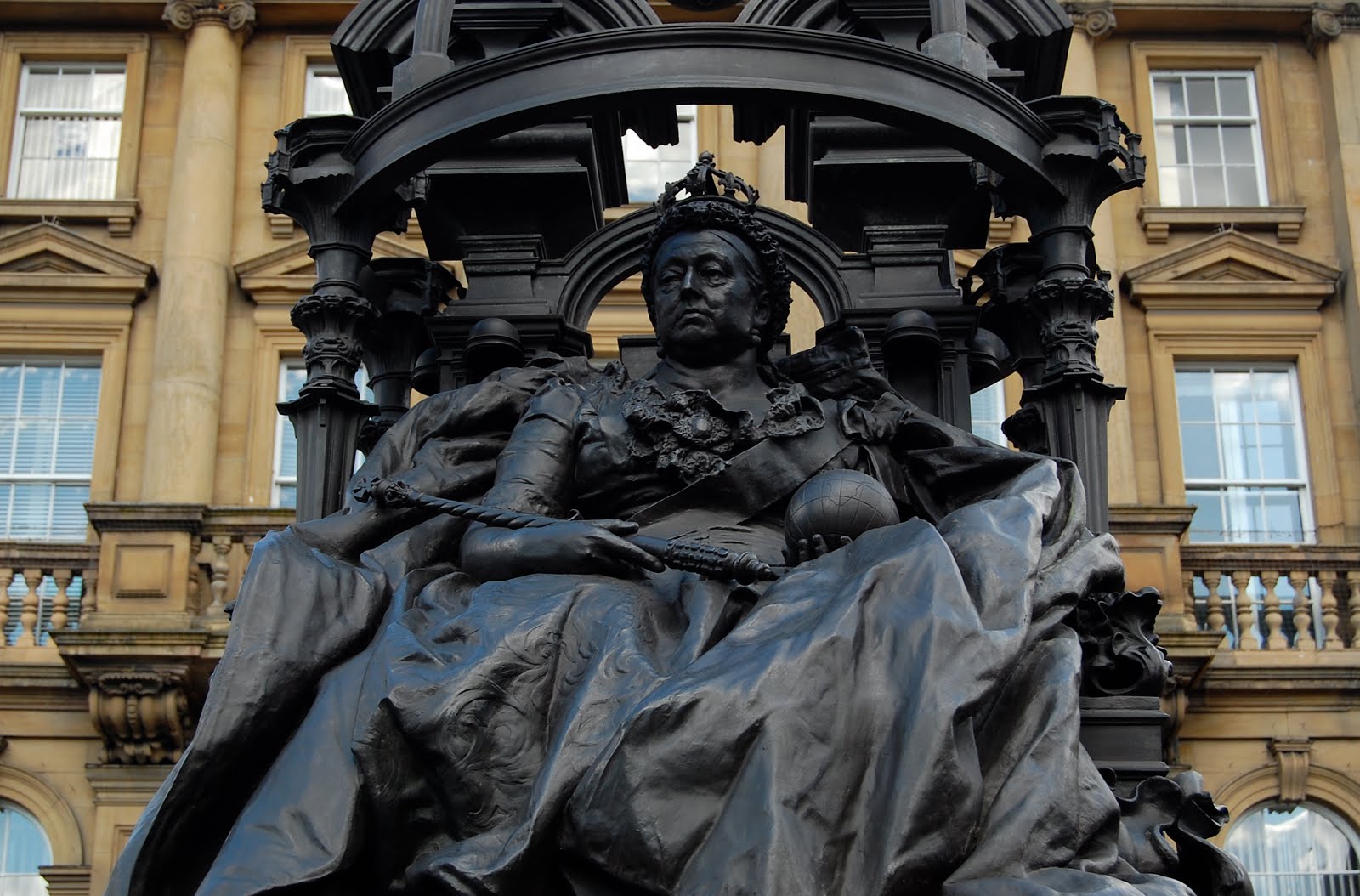
Queen Victoria by Alfred Gilbert, 1903, Newcastle
I have recently been rereading biographies of C19 sculptors-Alfred Gilbert and Auguste Rodin.

Their contrasting circumstances and characters and the ways in which they made their careers shed much light on the idea of the public sculpture.
As characters they could hardly have been more different. I would say that Gilbert was a self-dramatising extrovert and that Rodin tended more to introversion. Their families suffered considerably either way. Both  men were extremely hard working and both were laws unto themselves when it came to working on commisssions.

Rodin had the advantage of working in a culture where the state was highly interventionist and considered it important to provide studios where sculptors could work on government commissions.The  French sculptor could rely on a culture richly endowed with craftsmen. The pointers, mouleurs and bronze casters were all readily available He did not need to rent anywhere special to work on the Gates of Hell. Gilbert had to find his own workplace and his extravagant construction of a home and studio must have been one of the major factors which led to his insolvency and residence abroad.

To some extent Rodin and Gilbert shared a tendency to throw themselves into their work. Gilbert had a tendency to either wish to carry on working after an object was accepted and paid for-or to draw out a commission so long that he upset his patrons became quite irritated with him. The best example is the tomb of the Duke of Clarence which dragged on for years and must have seriously alienated the Royal Family.

 Rodin could drag things out too. This is illustrated through his attitude to the Balzac monument which was commissioned by a literary society. Rodin became obsessed with the project and consulted every possible visual and documentary source-even to the extent of travelling to Balzac's native region to look for similar physical types. All this turned out expensive for Rodin when his patrons became more and more anxious and eventually the commisssion was cancelled . And in the end the extraordinary image was too much for the literary society. They got someone else to do the work.

Gilbert was quite likely to spend  his fee and procrastinate when reminded that work was due. Rodin had a tendency to quote vague or inadequate fees in his enthusiasm for a project. His financial extravagance in older years was the purchase of antiquities -or what he thought were antiquities for exorbitant prices.


Alfred Gilbert, by Richard Dorment, 1985
Rodin:the shape of Genius,by Ruth Butler, 1993.
Rodin:by Frederic Grunfeldt, 1987.
Just how Butler manages to omit Rodin's encounter with the Cambodian dancers bemuses me still....

Tuesday, 4 May 2010

the permanent way

A little while ago there was a big sale of railway posters at Morphet's auction rooms. They were gorgeous and very expensive images. Most of them advertised the charms of this or that resort and did so with considerable skill. But one image struck me forcibly as it relates to an aspect of railways with which my family had some connection.
The poster design  at right, by Stanhope Forbes shows platelayers adjusting the track and this was the work done by my grandfather James Shell .The poster was also a surprise to me because it didn't seem to fit with what I knew of Stanhope Forbes an artist who was painting sentimental pictures in Brittany before Gauguin ever set foot there.


The photograph above shows a group of platelayers working near Linton in Northumberland and it was probably taken in the 1940s. My grandfather is standing second from right.