Friday, 7 May 2010

the sculptor's business

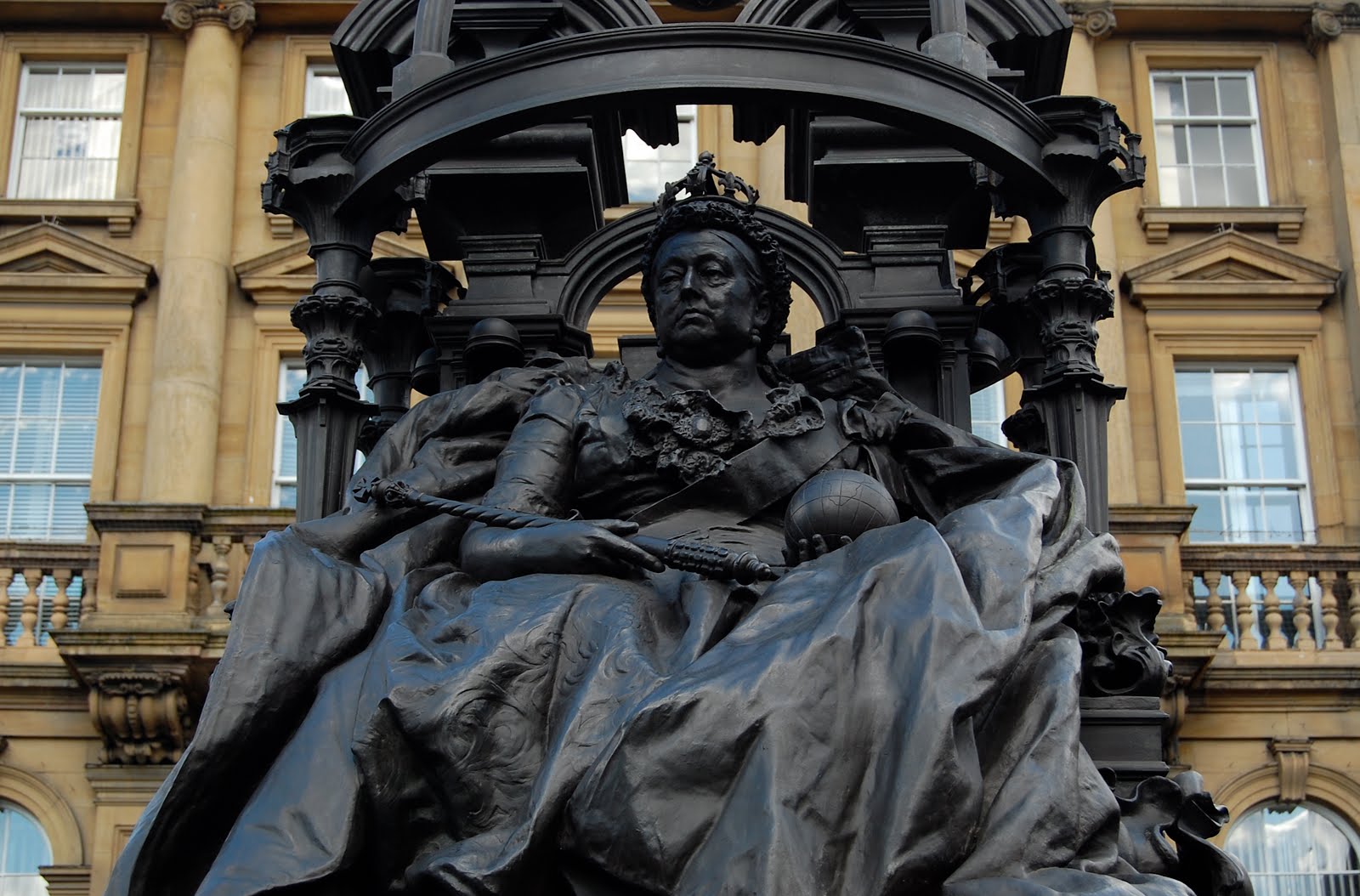
Queen Victoria by Alfred Gilbert, 1903, Newcastle
I have recently been rereading biographies of C19 sculptors-Alfred Gilbert and Auguste Rodin.

Their contrasting circumstances and characters and the ways in which they made their careers shed much light on the idea of the public sculpture.
As characters they could hardly have been more different. I would say that Gilbert was a self-dramatising extrovert and that Rodin tended more to introversion. Their families suffered considerably either way. Both  men were extremely hard working and both were laws unto themselves when it came to working on commisssions.

Rodin had the advantage of working in a culture where the state was highly interventionist and considered it important to provide studios where sculptors could work on government commissions.The  French sculptor could rely on a culture richly endowed with craftsmen. The pointers, mouleurs and bronze casters were all readily available He did not need to rent anywhere special to work on the Gates of Hell. Gilbert had to find his own workplace and his extravagant construction of a home and studio must have been one of the major factors which led to his insolvency and residence abroad.

To some extent Rodin and Gilbert shared a tendency to throw themselves into their work. Gilbert had a tendency to either wish to carry on working after an object was accepted and paid for-or to draw out a commission so long that he upset his patrons became quite irritated with him. The best example is the tomb of the Duke of Clarence which dragged on for years and must have seriously alienated the Royal Family.

 Rodin could drag things out too. This is illustrated through his attitude to the Balzac monument which was commissioned by a literary society. Rodin became obsessed with the project and consulted every possible visual and documentary source-even to the extent of travelling to Balzac's native region to look for similar physical types. All this turned out expensive for Rodin when his patrons became more and more anxious and eventually the commisssion was cancelled . And in the end the extraordinary image was too much for the literary society. They got someone else to do the work.

Gilbert was quite likely to spend  his fee and procrastinate when reminded that work was due. Rodin had a tendency to quote vague or inadequate fees in his enthusiasm for a project. His financial extravagance in older years was the purchase of antiquities -or what he thought were antiquities for exorbitant prices.


Alfred Gilbert, by Richard Dorment, 1985
Rodin:the shape of Genius,by Ruth Butler, 1993.
Rodin:by Frederic Grunfeldt, 1987.
Just how Butler manages to omit Rodin's encounter with the Cambodian dancers bemuses me still....

Tuesday, 4 May 2010

the permanent way

A little while ago there was a big sale of railway posters at Morphet's auction rooms. They were gorgeous and very expensive images. Most of them advertised the charms of this or that resort and did so with considerable skill. But one image struck me forcibly as it relates to an aspect of railways with which my family had some connection.
The poster design  at right, by Stanhope Forbes shows platelayers adjusting the track and this was the work done by my grandfather James Shell .The poster was also a surprise to me because it didn't seem to fit with what I knew of Stanhope Forbes an artist who was painting sentimental pictures in Brittany before Gauguin ever set foot there.


The photograph above shows a group of platelayers working near Linton in Northumberland and it was probably taken in the 1940s. My grandfather is standing second from right.

Thursday, 1 April 2010

Silverpoint drawing-how to do it

I like silverpoint drawing. It is an unusual technique which few artists use.It encourages delicate and controlled working for it is almost impossible to erase a mistake.

Silverpoint works because the silver is rubbed off the drawing point as it strokes the the the ground on which you draw . What you need to make a drawing is a piece of silver wire, the means of holding it comfortably and a prepared surface on which to draw. Any artist possessed of a little initiative can easily arrange these things.

I bought my silver wire from a jeweller in Newcastle.I first approached a silversmith in Carlisle but he gave me the brush off and seemed quite pompous about the whole thing....maybe he thought I was wasting his time. When you buy your wire explain what you want it for and an intelligent craftsman is likely to be more sympathetic and maybe interested-and will understand that you are not a competitor. An inch of wire will go a long way.Two could last a lifetime. As you can see from the illustration I mounted my wire in a plastic penholder. In the UK this is called a mapping pen. The nib was removed and the wire held in place with epoxy putty.When making your silverpoint bear in mind that silver is relatively soft and pliable so do not make it too long.Not more than about one half of an inch should protrude from the holder.

And now for the drawing surface-the ground as connoisseurs would call it.I use a fairly smooth paper and coat it with white gouache. The gouache should be quite thin and flowing. You should not aim for a plaster like surface. A chalky look to the paper will be enough. You might wish to tint the gouache slightly- a pink effect is sometimes found in Renaissance work.But go carefully-silverpoint produces delicate marks which darken somewhat as the silver on the paper tarnishes over the years.I have sometimes uses a dilute acrylic paint as the ground for silverpoint. This has the advantage of being waterproof but I do not think that it is as receptive to the silverpoint as a more chalky surface.You might consider adding some acrylic gel to the gouache if you want a slightly more waterproof surface-but the look should still be matte.

On a personal note my first attempt at silverpoint was made when I was a schoolboy. An old silverplated spoon made a rather awkward drawing implement and some white watercolour served as the ground.

Friday, 26 February 2010

Raymond Mason

Just yesterday I was rereading Raymond Mason's collected writings, At Work in Paris: now ,today I opened my newspaper to read the sad news of his death in Paris on 14 February. He was utterly unique and there was no one remotely like him on the UK or French art scene.

Mason is an artist who interests me because he had a highly original view of sculpture and was an excellent draughtsman.That he was also an excellent writer/speaker is also evident from the book I mentioned.I took it up because I wanted to refresh my image of Henry Moore whom Mason knew. Moore comes across as a genial but sometimes pompous soul who is concerned for his status and obviously saw himself as the leader of the first eleven of UK sculpture. Given the way many of his acolytes developed this was not necesarilly a good thing.

This contrasts with the line being put forward by theTate Britain who are trying to stress a darker more disturbing side to Moore's work. I don't see it myself and I will need some convincing for it seems to me that the curator has let his imagination run away with him and manufacturing something which cannot reasonably be found. Compared to Miro, Masson or Picasso he is far too genteel and the post war work of Moore is not evidence of a great old age.

But let me praise Mason for his remarkable drawings of townscapes and human anatomy. Let me also praise him for his willingness to make sculptures which deal with the disasters and sadness of contemporary life. The sculpture of the Tragedy in the North (the aftermath of a mining disaster) is too much in 3D to be called a relief and it is painted in the colours of life. I have often thought it grotesque and clumsy but even if that is the case it has a Hogarthian vigour which is unusual nowadays. My preference is for the earlier reliefs such as theBarcelona Tram .

Let me finish by mentioning some of the other texts in Mason's book. There is a beautiful essay on Cartier-Bresson -Mason seems to have known everyone in Paris - which describes Mason's experiences as sitter and observer of the photographer at work. There is a memoir of Dubuffet which is striking to say the least. He appears as very intelligent, generous,mercurial and irascible.There are also texts on Picasso, Giacometti,Balthus and various important dealers. Regarding Giacometti we find that Mason approves of James Lord's biography-his opinion differing from that of Sylvester.

At Work in Paris by Raymond Mason, Thames & Hudson 2003

Saturday, 20 February 2010

Poem

Ellingham
Bellingham
Eglingham
Edlingham
Beltingham

(the words all end in a "jum" sound)