Thursday, 20 June 2019

Dunstanburgh-or Not?


This small watercolour above, by Turner, is on show in Berwick with a small selection of other works by him depicting Northumbrian scenes. The exhibition runs until 13 Oct 2019.

The sketch is part of the Turner Bequest and the cataloguers and commentators on the painting are uncertain what it it represents. They are right to be uncertain. Some, like Eric Shanes believe that it is likely a view of Dunstanburgh: others such as David Hill are reported as believing that Shanes is wrong. I tend to Hill's viewpoint.

The sun is either rising or setting. You can see its reflection in the water.If the central mass represents the bluff on which Dunstanburgh is sited-  and it does look a little like the view from the Heugh to the South, then the sun is rising quite far to the North. Would that really be possible even at midsummer?. It is most unlikely to be sunset but I suppose someone might claim that the light is reflecting in the meres inland of the castle.Nothing really fits.

When I first looked at the photo it seemed to me that Turner is showing a windmill on the left of what may or may not be a rocky outcrop. There seems to be a windmill and some trees to the right of it.There seem also to  be a couple of hesitant mark above but I now see that these are being interpreted as hints of a castle. The marks are crude and do not correspond to any possible viewpoint for Dunstanburgh.

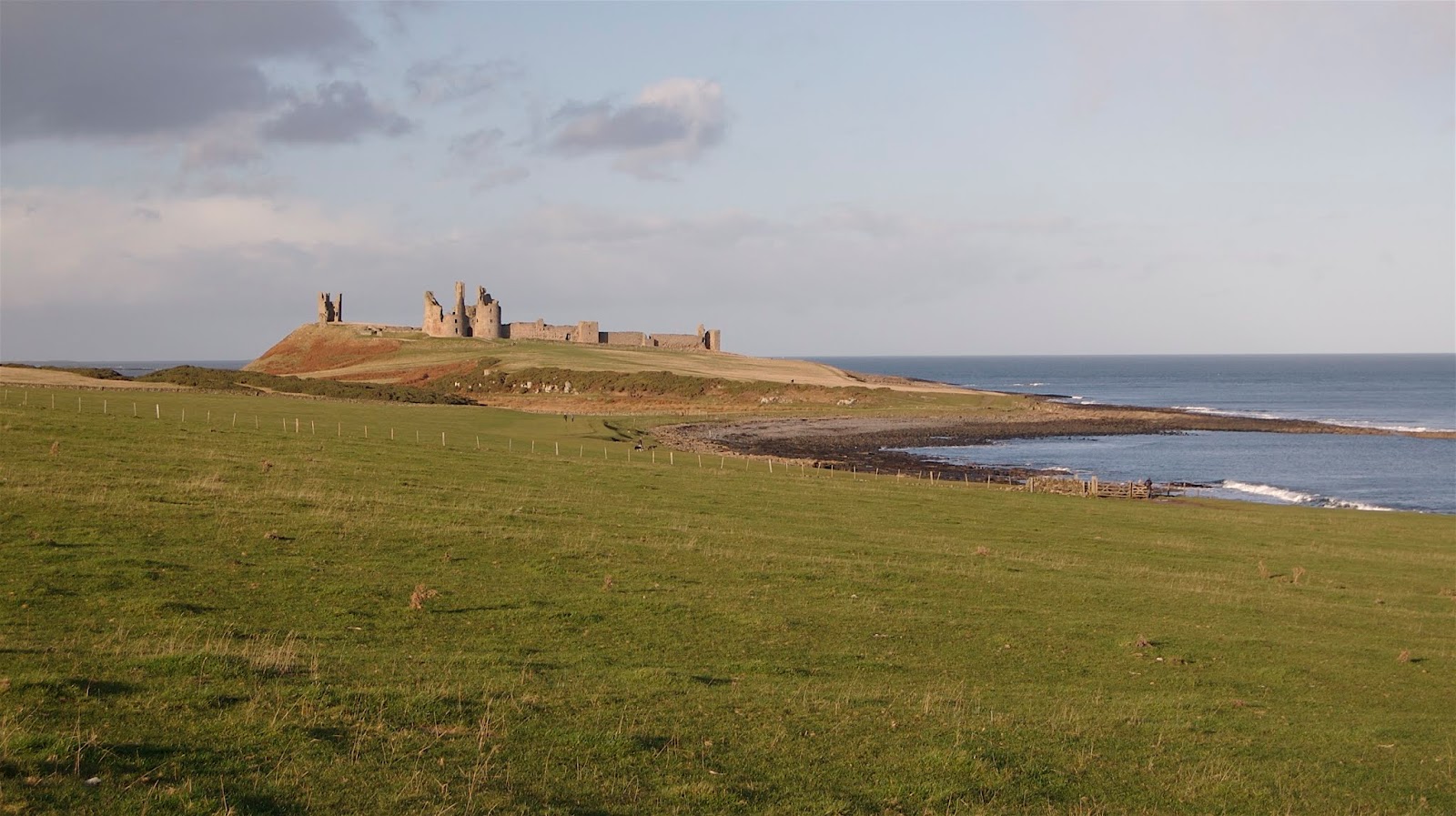
I have walked over this area since childhood and still do so regularly. I have never heard or seen any traces of a windmill at Dunstanburgh. It can be a windy place but who would want to take their corn to such an isolated spot?I have also seen many illustrations of Dunstanburgh by artists such as by John Varley and the A W Hunt drawings of Dunstanburgh at the Ashmolean. In none of them, if I remember rightly does a windmill appear.

 Turner's views of Dunstanburgh are usually from the South and he at least understood the uneven nature of the site which falls from left to right in his views, something which is not always observed by artists. The fall in reality can be so extreme that it can appear that the base of the Lilburn Tower is higher than the top of the Eggynclough Tower.

Addition Nov 21,2020
I cannot find anything to suggest that this is really a watercolour of Dunstanburgh, or even the start of one.
You can see a photo of the drawing   in Gerald Wilkinson's Turner's Colour Sketches 1820-1834,this is clearer than my illustration.He calls it Promontory and Setting Sun  (page 191). It seems to me quite significant that Wilkinson makes no identification whatsoever for the subject.This work just cannot be Dunstanburgh, it has more of the block like nature of Warkworth-but I'm not suggesting that it is Warkworth.


Loch Creran, Argyll.


Sunday, 24 February 2019

BONNARD EQUALS BOX OFFICE-HOW MUSEUMS ABUSE MASTERPIECES

Bonnard: View of the River, Vernon . It is in fact a view of his garden at Vernonnet with the Seine in the distance. Painted 1923.Edinburgh.

I have been reading the catalogue of the current Bonnard exhibition at the Tate and it has caused me some concern.It took quite bit of study to work out just which works are in the exhibition and to the best of my calculation I believe that it contains 91 paintings, several drawings and modern prints of Bonnard's photographs.


The exhibition is founded on the excellent Bonnards from the collection of Tate Modern along with some accompanying drawings. It also includes the two fine Bonnards from Edinburgh. So for quite some time members of the public will be unable to see these excellent paintings without paying a substantial fee. They will also be exposed to the vicissitudes of travel to at least one other venue. As far as I can see all of the  paintings are going to the Denmark showing and possibly also to Vienna. In Vienna the venue is a kunsthalle which has no collection of its own from  which to contribute.

To the best of my knowledge the Tate paintings are not usually displayed together in their home, but they are in this show. A lover of Bonnard would like to see this but equally a lover of Bonnard would have grave concerns about the presentation of such gorgeous paintings in  that joyless, underinvigilated, inhospitable mausoleum known as Tate Modern. But better  that they are preserved  because I don't really think that the Tate is fit to have custody of them.They would be more at home in the National Gallery.

Do not buy the catalogue.It really does not contribute anything of substance to Bonnard studies at all.Also, many of the illustrations are dreadful reproductions of the originals.The catalogue for the earlier Tate show is much better and if you want a general book on Bonnard you might as well read Tim Hyman's text. At least a painter is reflecting on another artist's work.

Also in the exhibition are old standards such as the standing nude from Brussels, the couple from Paris and the Atelier with Mimosas also from Paris.I have seen many Bonnard exhibitions starting with the unsurpassable show at the R.A of 1966 and these paintings have been in most of them.  I yield to no one in my love for Bonnard but possibly the most interesting-because critical- review of the exhibition that I have seen come from-of all people- Adrian Searle in The Guardian. He admits that he is not one of Bonnard's greatest fans but I do find that some of his reservations are very understandable. It isnt the usual Bonnard=bonheur equation by any means. For that reason alone it is worth a look.

Monday, 9 July 2018

MILLICENT FAWCETT-MORE MEDIOCRE SCULPTURE

I have touched on the subject of modern figurative sculpture and the nature of sculptural  quality or lack of it in an earlier post. Here I discuss the very new  sculpture of Millicent Fawcett in Parliament Square.It is another of Ms Wearing's productions.The following should really be read in conjunction with my earlier post which illustrates examples of what would generally be accepted as poor  or good quality modelling.
Millicent Fawcett staue, Parliament Square, Gillian Wearing,installed 2018. 

 It took until 2018 for a statue of an important suffragist to arrive in Parliament Square. In typical British fashion there isn't quite a consistent theme in the choice of subjects for sculptures in the Square.Is this some kind of British pantheon? But statues of Lincoln and Mandela  among many others are  there. Personally I can see no reason for Mandela's presence other than blind sentiment. I admire Lincoln but  both he and Mandela were foreigners. They only go to prove that, worthies though they may be the choice of subjects for public sculpture in the UK is at best capricious.  But this new sculpture is a mediocre piece of work and that is nothing to celebrate at all. It is true that most of the statues in Parliament Square are of poor quality.  And this example, on the evidence of photos is no exception.

 Ms Wearing is no modeller. Mrs Fawcett's head looks blocklike and lacking animation. She and her team have produced nothing which rivals Nigel Boonham's recent Martin Luther King.

It is obvious that I am not the only one wondering why Ms Wearing was chosen. Here is a letter to the Guardian from Martin Jennings with which-at least on the nature of the modelling- I agree. Mr Jennings is a sculptor. He is one of those catering to the current UK craze for commemoration. He is not correct to say that A Real Birmingham Family is her (only) "other misguided foray into the artform". She and her teams have produced similar works in Italy and Denmark. On photographic evidence it seems that the quality is again very poor.

Contemporary sculpture is a broad field comprising multiple forms of practice. Sculptors do their best work when they deploy their proven expertise rather than when they wander into other areas of which they have little experience. You wouldn’t appoint a plumber to fix your wiring, so why ask a conceptual artist to make your statue?
It is dismaying to see that Gillian Wearing, a celebrated and interesting conceptual artist, has been chosen to make the statue of Millicent Fawcett in Parliament Square (Report, 14 April). There are several women sculptors in this country with the necessary years of specific experience required to erect a compelling statue in Parliament Square next to Epstein’s figure of Jan Smuts and Ivor Roberts Jones’s great monument to Churchill. Wearing is not one of them, as evidenced by her one misguided foray into the artform to date – the lamentably formless A Real Birmingham Family. We are told she was selected to make the statue of Fawcett by so-called “cultural leaders”. What bias led these experts to ignore the evidence that Wearing’s abilities lie elsewhere?
Martin Jennings
Witney, Oxfordshire


The term "cultural leaders " is indeed grotesque. Are we talking in artistic or anthropological terms? Did any of these cultural leaders have understanding of artistic quality, or knowledge of  sculptural tradition? It seems that the answer is "No".

At least this one was cast in the UK . It wouldn't have looked very good if it had been fabricated in China, would it?


I'll grant that Ms Wearing had a challenge in portraying a woman who was alive more than a century ago.How woud you depict her except in the clothing of her own day?

So what would she do? Ms Wearing has her holding out a sheet or banner with some of Mrs Fawcett's words. I am not the first to suggest that it looks as if she is hanging out washing. I also suggest that she grips the banner in a peculiarly  awkward and slightly uncomfortable manner-just look at her hands.

Her body- language is not proclaiming something to the effect that, these are my words, look at them and take notice.It is passive and apologetic, not unlike those silent people in you see in the street who hold religious leaflets in their hands which you can accept or ignore.But perhaps that is what was wanted, a figure frozen in expressive mid-gesture might not look so dignified; she wasn't an impulsive  Pankhurst after all. Mrs Fawcett may have been a respectable Victorian matron but I think that she could have managed a more dynamic pose.

I have tried to find something redeeming about this sculpture but it doesn't offer much.It was a reasonable idea to add photos to the base but the plinth seems rather half-hearted and there doesn't seem to have been much thought about it. The sculptors of the past could have designed their own plinths to emphasise and complement their figures. The lettering on the base is of only average  quality. Surely no letter carver of quality has worked here?

Monday, 16 April 2018

IONA NORTH END-FROM A PEPLOE VIEWPOINT

IONA NORTH END-FROM A PEPLOE VIEWPOINT
This is a gouache painting I made from a drawing done last year on Iona.I stood as near as possible to the spot in which  Peploe must have placed himself to do his oil. At this place you are surrounded by unusually shaped rocks. Some of these have been given names by the many artists who have flocked to Iona, especially in the C20. You are within yards of Cathedral Rock and Pulpit Rock.

As I said this is a gouache painting. If you haven't used gouache before let me say that it has two particular characteristics: it dries to a chalky, non-glossy surface  and it can be a little difficult to visualise the colour it will take when dry. Cadell would certainly have liked the idea of a chalky surface. But I don't see much evidence of his using gouache.In his time it would have been associated with commercial art where permanence was little valued. Nowadays the quality of gouache paint is vastly improved.