What partly prompted this post was my rereading of The Riddle of the Sands, the 1903 novel by Erskine Childers which is set in the Frisian islands and the lagoon which they shelter. It is a classic of the spy/messing about in boats genre. I noticed that Baltrum is mentioned-literally in passing and remembered that Klee had visited the island.
Childers is good at evoking the tides and scenery of this constantly changing land and seascape where tides break on constantly changing sand dunes and channels and boats can go aground very easily.This is a flat landscape. Nowadays tourists are welcome but not their cars or bicycles. How wise!
Here is Childers' description of what it was like when the yacht ran aground in in the area.
"For miles in every direction lay a desert of sand.To the north it touched the horizon.... To the east it seemed also to stretch to infinity.....To the south it ran up to the pencil line of the Hanover shore. Only to the west was its outline broken by any vestiges of the sea it had risen from. There it was astir with crawling white filaments, knotted confusingly at one spot in the north-west, whence came a sibilant murmur like the hissing of many snakes. Desert as I call it , it was not entirely featureless. Its colour varied from light fawn, where the highest levels had dried in the wind, to, brown or deep violet where it was still wet..." page 113.
One or two of the works are more realistic-such as one of the dune views and a view perhaps from the guest-house where he stayed. He made two works which refer in their title to the fact that the dunes were being stabilized-by planting grass or whatever method was in use at that time. These have a more realistic aspect . I have no doubt that Klee would be interested in the contents of rock pools and the structure of seaweed.
Incidentally Jurg Spiller in The Thinking Eye says that Klee started collecting this sort of material on visits to the Baltic. But I cannot find any evidence that Klee visited the Baltic shoreline.This visit to Baltrum would be a possible starting point for such collecting. A serious chronology of Klee's life is surely needed and I have used the outline provided by Sabine Rewald.
But frequently in the Baltrum work one could say that Klee responded to the landscape in a more abstract sense. Sky and horizon and the parallel waves of the sea. One notices watercolours in a style closely relating to the Tunisian watercolours made just over 10 years earlier. It's a question of piled up squares of colour plus details such as a house.This is a style which he also develops in later works relating to his Sicilian holiday. In the Baltrum works there is almost no trace of the Klee whimsy so common in other work from this period-particularly the so-called oil-transfer drawings.
In North Sea Picture we see again the breaking waves far out from shore. Emphasis on the sky/horizon/sea divide, by now an old trope in modernist art, is found in North Sea Island-looking towards Langeook (1923:180)
Klee took a few holidays especially in the Twenties-which, probably not coincidentally was the period when he was a salaried teacher at the Bauhaus. Many of Klee's later holidays involved trips to coastal or island areas-Brittany, Elba and Porquerolles, Corsica also come to mind. He was often to stay in coastal areas and sometimes in hotter places such as Sicily and Egypt.
Klee's visit to Baltrum occurred in the late summer of 1923. You will remember that 1923 was the year of the great collapse of the German currency and a period of incredible hyperinflation. This process had already become obvious when Klee left for the island. It was to escalate vastly in November of 1923. Despite any effect this might have had on the family finances I feel that no influence can be detected on his art. But it must have seemed a slightly surreal state to be in nevertheless. On his way home he called on Schwitters and El Lissitzky.
Erskine Childers: The Riddle of the Sands, Atlantic Books, 2009.
Paul Klee: Catalogue Raisonné, Vol 4, Paul Klee Founation, 2001.
Sabine Rewald:Paul Klee: The Berggruen Collection in the Metropolitan Museum of Art, 1988.
Childers is good at evoking the tides and scenery of this constantly changing land and seascape where tides break on constantly changing sand dunes and channels and boats can go aground very easily.This is a flat landscape. Nowadays tourists are welcome but not their cars or bicycles. How wise!
Here is Childers' description of what it was like when the yacht ran aground in in the area.
"For miles in every direction lay a desert of sand.To the north it touched the horizon.... To the east it seemed also to stretch to infinity.....To the south it ran up to the pencil line of the Hanover shore. Only to the west was its outline broken by any vestiges of the sea it had risen from. There it was astir with crawling white filaments, knotted confusingly at one spot in the north-west, whence came a sibilant murmur like the hissing of many snakes. Desert as I call it , it was not entirely featureless. Its colour varied from light fawn, where the highest levels had dried in the wind, to, brown or deep violet where it was still wet..." page 113.
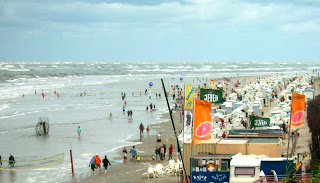 |
| Beach at Baltrum-note waves breaking out to sea from Wikepedia entry on Baltrum here
On looking up the island on Wikipedia I found a photo which immediately suggested one of Klee's Baltrum works. It is a characteristic of this landscape to see waves breaking at a substantial distance from the shore. Look at the row upon row of breakers in Klee's painting and compare it with the photograph above.
|
 |
| North Sea Picture
In North Sea Picture (1923:242) we see again the breaking waves far out from shore. Emphasis on the sky/horizon/sea divide, by now an old trope in modernist art, is found in North Sea Island-looking towards Langeook (1923:180
|
One or two of the works are more realistic-such as one of the dune views and a view perhaps from the guest-house where he stayed. He made two works which refer in their title to the fact that the dunes were being stabilized-by planting grass or whatever method was in use at that time. These have a more realistic aspect . I have no doubt that Klee would be interested in the contents of rock pools and the structure of seaweed.
 |
| Stabilized Dune on Baltrum 1923, 262. |
But frequently in the Baltrum work one could say that Klee responded to the landscape in a more abstract sense. Sky and horizon and the parallel waves of the sea. One notices watercolours in a style closely relating to the Tunisian watercolours made just over 10 years earlier. It's a question of piled up squares of colour plus details such as a house.This is a style which he also develops in later works relating to his Sicilian holiday. In the Baltrum works there is almost no trace of the Klee whimsy so common in other work from this period-particularly the so-called oil-transfer drawings.
In North Sea Picture we see again the breaking waves far out from shore. Emphasis on the sky/horizon/sea divide, by now an old trope in modernist art, is found in North Sea Island-looking towards Langeook (1923:180)
Klee took a few holidays especially in the Twenties-which, probably not coincidentally was the period when he was a salaried teacher at the Bauhaus. Many of Klee's later holidays involved trips to coastal or island areas-Brittany, Elba and Porquerolles, Corsica also come to mind. He was often to stay in coastal areas and sometimes in hotter places such as Sicily and Egypt.
 |
| View from a Window- North Sea Island 1923, 259 |
Erskine Childers: The Riddle of the Sands, Atlantic Books, 2009.
Paul Klee: Catalogue Raisonné, Vol 4, Paul Klee Founation, 2001.
Sabine Rewald:Paul Klee: The Berggruen Collection in the Metropolitan Museum of Art, 1988.


