ART/ART/ART My own paintings and those of artists I admire.Also some how-to-do-it posts about landscape painting.
Wednesday, 28 September 2016
Thursday, 28 July 2016
OIL SKETCHES OF NORTHUMBERLAND
Here are a couple of recent oil sketches of Northumbrian scenes. They are quite small and intended as ideas for paintings on a larger scale.I have added surrounds which will give an idea of the kind of dark frame which might be appropriate for the subject. Oil seed rape is now part of the Northumberland landscape and provides a strong colour note.
![]() |
| Towards Cheviot from somewhere in the Ratcheugh area. |
![]() |
| Late Spring. |
Labels:
landscape.,
Northumberland,
oil,
pochade,
sketch
Tuesday, 19 July 2016
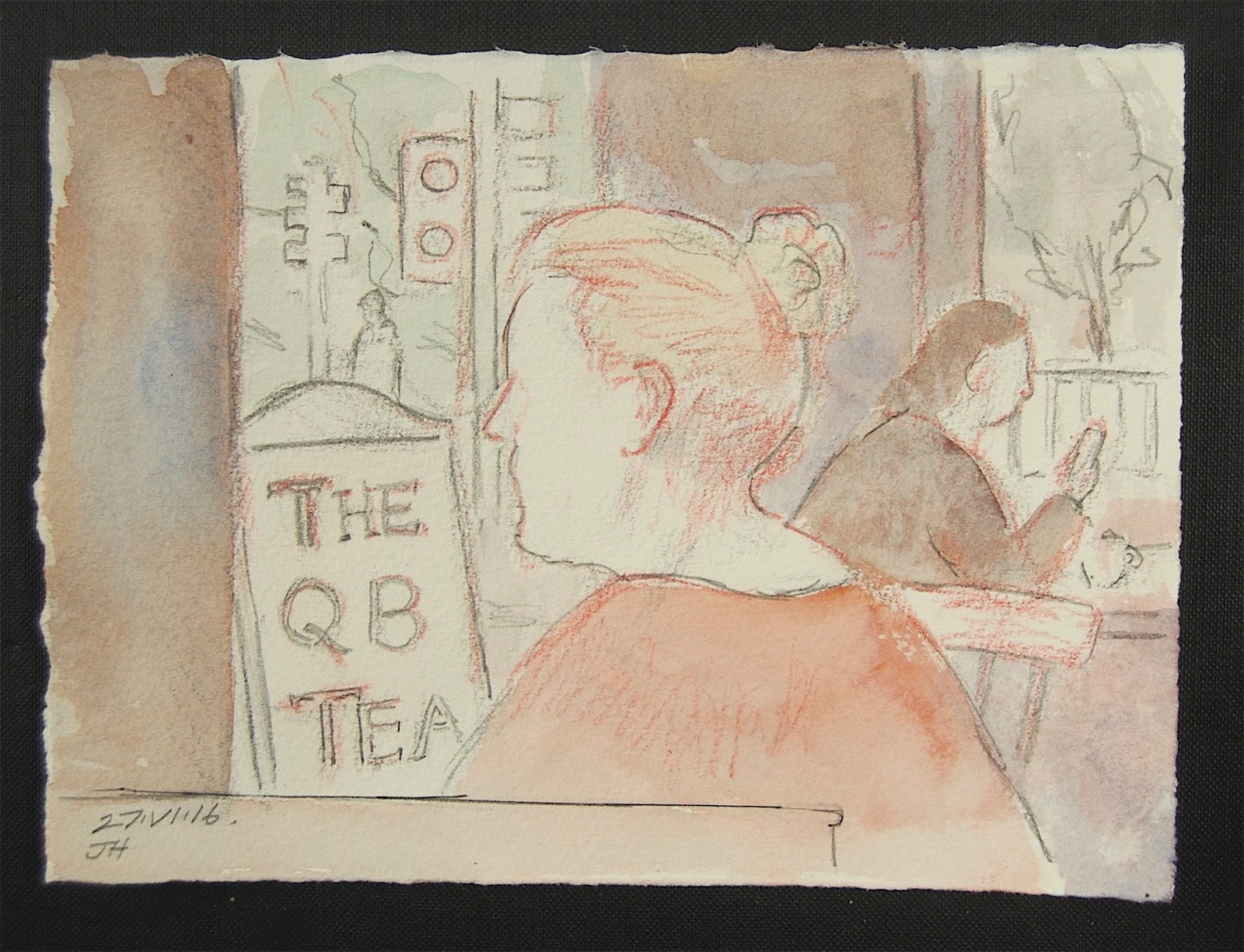
CAFE DRAWINGS
In an earlier post-which you can see here- I talked about drawing people from observation and I discussed mainly the possibility that you can draw people-quickly-on buses and at cashpoints. There are plenty of other possible locations. I am sure that you will find places that I have not thought of. But if you go to cafes then you have the chance of drawing people from life. Another group of these drawings-showing parents and children can be seen here.
My local branch of Costa has a large plate glass window looking onto a busy street and is next door to a supermarket. So it is a good place to watch the world go by. There is also a pedestrian crossing immediately adjacent so people halt there before crossing the road-and you have the challenge of trying to draw them-quickly!
As you see none of these drawings comes from a sketchbook.There is nothing wrong with sketchbooks . They keep your work together in one place but they are perhaps more noticeable-they take up more space than a piece of paper removed from a small folder.
My purpose in doing these drawings is firstly to practice obsevation and drawing skills and the ability to work quickly.I do intend to put more figures into my landscape painting. There they can form a focal point. It is something that landscape painters do not do so much nowadays.The reason may be that they think that lack of figures allows the viewer to identify more readily with the scene-they have it all to themselves. But perhaps that is too sophisticated a view Most likely artists just have not practised their life drawing and so are incompetent to do any such thing. Monet,Sisley and Pissarro knew better.
![]() |
| Checking the shelves at Costa |
![]() |
| Two for the price of one. |
![]() |
| At Quilliam Bros' |
![]() |
| At Quilliam Bros again. |
![]() |
| Young person absorbed with her smartphone-at Quilliam's again. |
Thursday, 30 June 2016
ONE OF THE MISSING OF THE SOMME-JOHN DAVID NISBET- DIED 1 JULY 1916
![]() |
| Memorial plaque; St Peter & St Paul , Longhoughton |
When I was a child the names on the War Memorial in Longhoughton Church did not mean much to me.But later on I was told that one of the names was that of my great uncle John David Nisbet.It is next to last on the righthand side of the plaque. As I got to know the village better I recognised local names still well known in my youth-Foreman,Stanton, Wood, Douglas and Dodds. Some of these came from families which not only served in the military but provided crews for the lifeboat at Boulmer.
John came to England a child when the family moved there from Midlothian.His father's work as a gamekeeper had brought him to Northumberland.
John David Nisbet died on 1 July 1916 on the first day of the Battle of the Somme. He had just passed his 17th birthday and was in fact 17 years and three months old. His actual birthday was 2nd March 1899 and he passed his 17th birthday in France.This suggests to me that there is something in the family stories that John was tall for his age and was teased and harassed into running off to join up. He was one of the tens of of thousands who responded to the call for volunteers. The response was so overwhelming that recruiting centres struggled to cope.It is no wonder that this sixteen year old-and no doubt quite a few others- slipped through. Johnnie Nisbet's story is hardly unique.
![]() |
| John David Nisbet. Private 20/1708 Tyneside Scottish (Northumberland Fusiliers) |
Soldiers were not sent off to the front immediately after enlisting, so a period of some months training must have occurred before his going out to France,and this confirms that he did sign up when underage.If it is correct that the minimum age for Pals battalions such as the Tyneside Scottish was 19 then something seems seriously wrong here.
I am left wondering what to think of John David's rush to join up and then to die so young. Mostly I am bemused by this. Quo fata vocant, indeed.
John Nisbet's body was never found and his name is recalled on the Thiepval Memorial.
He probably knew another Longhoughton man-John Kim Butters (20/313) had been in the same battalion though he was a bit older. He died in June of 1916. Both were in the 20th Battalion of the Tyneside Scottish (Northumberland Fusiliers) This was part of 102 Brigade, 34th Division at la Boiselle near Albert.
He would have heard the enormous explosion of the Lochnagar and other associated mines, felt the earth shaking and the dreadful silence which must have followed and was broken by the whistle for the advance.Did he hear, is there any way he could have actually heard through what must have been an unbelievable cacophony, the sounds of the bagpipes playing as they did? And then did he really advance with his comrades at walking pace in the expectation that the German wire had been cut?
(See also my post about the substantial and very interesting stained glass windows at nearby Lesbury which are the memorial to another local man who died at the Somme and portray the troops going out-7.30 am,1 July 1916. Access it here)
Monday, 20 June 2016
A MEMORIAL OF JULY 1 1916- THE FIRST DAY OF THE BATTLE OF THE SOMME.
The small church of Saint Mary at Lesbury in Northumberland has an intriguing memorial of the Great War. It is a group of three windows in the south wall of the nave. They are full of symbolism .There is reference to two members of the Scott family who had strong local connections. The windows particularly commemorate the death of George Henry Hall Scott on the first day of the battle of the Somme, July 1 1916. And what is more the design goes out of its way to memorialise that day and the Franco-British collaboration on this front. The window is the product of the Archibald K Nicholson Studios.This was obviously a firm which could produce high quality glass if not particularly inspired glass.. It continued into the 1960s and Nicholson lived from 1871-1937.
The window was commissioned by Captain Scott's mother- Lady Henrietta Scott. Her husband, Sir Henry Hall Scott who was Captain Scott's father had died in 1911 and the window is partly to commemorate him.The family had a local connection with Hipsburn and among other things Sir Henry founded the Imperial Yeomanry for the South African War.
Captain Scott was born in Northumberland and by profession was an engineer. He was in the 7th Battalion of the Queen's Royal West Surrey Regiment. His age at death was 34. He is buried in the Dantzig Alley Cemetery, Mametz-not far away from where he died.
Much is made of the Anglo French collaboration in the Great War and military circumstances have obviously suggested this theme. I cannot sufficiently stress its importance for the scheme of the design.
The three windows have conventional depictions of-from east to west-St George,The Angel with the Crown of Victory,and St Joan of France. It is the lower panels of the windows which have the most detailed interest.
When you look at the lower panel of the St George window which illustrates the alliance you see that there are British troops on the left going out to attack Montauban and French troops are shown on the right setting out to capture Hardecourt. These places were respectively at the southern end of the British Fourth Army sector and the northern end of the French Sixth Army sector. So the British and French armies are advancing to take places only a mile or two apart.Both actions were in fact successful. On the left the British soldiers have just left their trench. On the right the French troops are setting out.Lest anyone could possibly forget the time of the offensive it is listed as "7.30 am.THE FIRST OF JULY 1916 on a scroll to the left of the scene, The objectives Montauban and Hardecourt are named clearly in the glass.The significance of Montauban is that it was a ridge in a commanding position:so too the hill at Hardecourt,
The lamb and flag of St George appear in the lower panel of the central window with the inscription GLORIA: IN: EXCELSIS: DEO on the left of the panel and ET:IN:TERRA:PAX on the right.The lamb of course symbolises Christ. Nearby is a chalice, referring to communion and sacrifice-Christ's sacrifice and by implication that of Captain Scott.Below the altar are the figures of Martyrs with particular associations with Britain.
The third window shows St Joan. In a cartouche above the panel are the words BEATA:JEANNE:D'ARC. The panel below shows her on horseback. Once again there is reference to martial glory.Her flag is mentioned with its slogan "De par le Roy du Ciel" (By God's Will). To the right is is shown the fleur-de-lys and the French war cry "Montjoye Saint-Denis". The cross of Saint George is on the left side.
There is additionally a plaque commemorating Captain Scott-placed there by his regiment.
At one time the official explanation of the iconography hung in the church but I did not notice it on my last visit.I photographed it in 2008.Other information is available on the internet.
A note about my great uncle who enlisted under -age and also died on the first day of the Somme can be found in the post about the war memorial plaque at nearby Longhoughton church. You can find it here.
The window was commissioned by Captain Scott's mother- Lady Henrietta Scott. Her husband, Sir Henry Hall Scott who was Captain Scott's father had died in 1911 and the window is partly to commemorate him.The family had a local connection with Hipsburn and among other things Sir Henry founded the Imperial Yeomanry for the South African War.
Captain Scott was born in Northumberland and by profession was an engineer. He was in the 7th Battalion of the Queen's Royal West Surrey Regiment. His age at death was 34. He is buried in the Dantzig Alley Cemetery, Mametz-not far away from where he died.
Much is made of the Anglo French collaboration in the Great War and military circumstances have obviously suggested this theme. I cannot sufficiently stress its importance for the scheme of the design.
The three windows have conventional depictions of-from east to west-St George,The Angel with the Crown of Victory,and St Joan of France. It is the lower panels of the windows which have the most detailed interest.
![]() |
| British and French Soldiers starting their advance on the first day of the battle of the Somme. |
![]() |
| French Soldiers |
![]() |
| The Central, Angel Window. |
![]() |
| Lamb and Flag, also the badge of Capt Scott's Regiment. |
![]() |
| St Joan Window |
![]() |
| Lower panel, St Joan Window. |
At one time the official explanation of the iconography hung in the church but I did not notice it on my last visit.I photographed it in 2008.Other information is available on the internet.
A note about my great uncle who enlisted under -age and also died on the first day of the Somme can be found in the post about the war memorial plaque at nearby Longhoughton church. You can find it here.
Subscribe to:
Posts (Atom)